
Pre-Advanced 1 Bootcamp
Mastery Track - Level 13

Coach Shaun
What you will learn
Use modals of deduction to talk about locations, quantifiers to describe architecture, and write informal letters that share details about a neighborhood.
Improve your use of reported speech and various reporting verbs to discuss news and current events, and engage comfortably in general conversations with informal language.
Use the passive voice to describe shows, learn defining and non-defining relative clauses to give extra information, and make suggestions using language for voicing expectations.
Practice second and third conditionals to discuss job-related scenarios, provide reassurance in conversations, and write advice emails with practical career tips.
All courses operate on CET (Central European Time). Times are converted to your local time, but please be aware that time shifts in your region or CET during the Bootcamp may cause your session time to adjust. For example, a class starting at 6 a.m. could move to 7 a.m. if daylight saving time changes occur.
Course schedule
Unit 43 - Different places
Lesson 1 - Learn modals of deduction.
At the end of the lesson, students can use modals of deduction to talk about different places.
Zoom
Unit 43 - Different places
Lesson 2 - Expand use of quantifiers (some, any, no, none of, none) as well as quantifiers for large quantities (a lot of / lots of, many / much / plenty of) and quantifiers for small quantities (a few, a little, few, little, very few, very little, not many).
At the end of the lesson, students can talk about architecture and describe buildings using quantifiers, including quantifiers for large quantities and small quantities.
Zoom
Unit 43 - Different places
Lesson 3 - Learn language for offers and polite requests. Learn to differentiate the verbs borrow and lend.
At the end of the lesson, students can make offers and polite requests in the context of neighbor relationships.
Zoom
Unit 43 - Different places
Lesson 4 - Learn to write an informal letter to guests renting their home.
At the end of the lesson, students can write an informal letter describing a neighborhood, including how to get around, safety information, restaurants, stores, entertainment, etc.
Zoom
Speaking Practice
Zoom
Unit 44 - They said...
Lesson 1 - Review reported speech: statements, questions, and reporting verbs say and tell.
At the end of the lesson, students can use reported speech to talk about the news and current events.
Zoom
Unit 44 - They said...
Lesson 2 - Expand understanding of reported speech and learn various reporting verbs. Learn reporting verb + gerund vs infinitive. Learn different reported speech verb patterns.
At the end of the lesson, students can use reporting verbs and reported speech with greater confidence.
Zoom
Unit 44 - They said...
Lesson 3 - Learn informal language for small talk, including expressions for speaking generally (typically, generally, in general, on the whole, normally).
At the end of the lesson, students can engage in small talk, and they can speak in a general and non-committal manner.
Zoom
Unit 44 - They said...
Lesson 4 - Learn to write a summary of an article. Learn to use coordinating conjunctions and commas to combine clauses.
At the end of the lesson, students can write a summary of a sports article, using adverbs to comment on a story.
Zoom
Speaking Practice
Zoom
Unit 45 - Entertainment
Lesson 1 - Learn passive voice, various tenses.
At the end of the lesson, students can use the passive voice to talk about their favorite show or series.
Zoom
Unit 45 - Entertainment
Lesson 2 - Learn defining and non-defining relative clauses. Learn relative pronouns who, that, which.
At the end of the lesson, students can use defining and non-defining relative clauses to effectively give more information about something. Students can differentiate intonation for defining vs non-defining relative clauses.
Zoom
Unit 45 - Entertainment
Lesson 3 - Expand understanding of relative clauses.
At the end of the lesson, students can use relative clauses with greater confidence while talking about entertainment.
Zoom
Unit 45 - Entertainment
Lesson 4 - Learn language to make and respond to recommendations and suggestions. Learn to use be supposed to for voicing expectations about something when making recommendations.
At the end of the lesson, students can make recommendations and suggestions for entertainment.
Zoom
Speaking Practice
Zoom
Unit 46 - Jobs
Lesson 1 - Learn to the second conditional, including If I were you. Learn differences in usage between second conditional compared to first conditional.
At the end of the lesson, students can use the second conditional to talk about the things they would like to do.
Zoom
Unit 46 - Jobs
Lesson 2 - Learn the third conditional.
At the end of the lesson, students can use the third conditional to talk about imagined past events related to jobs and having a business.
Zoom
Unit 46 - Jobs
Lesson 3 - Learn language to give reassurance.
At the end of the lesson, students can provide reassurance in the context of job hunting.
Zoom
Unit 46 - Jobs
Lesson 4 - Learn to write an email to give advice.
At the end of the lesson, students can write an advice email to someone about a job, explaining what the person would do in this position and why it would suit him or her.
Zoom
Speaking Practice
Zoom

Your Path To English Fluency Starts Here - Invest in Yourself Today!
The Speak EnglishAccelerator Bootcamp
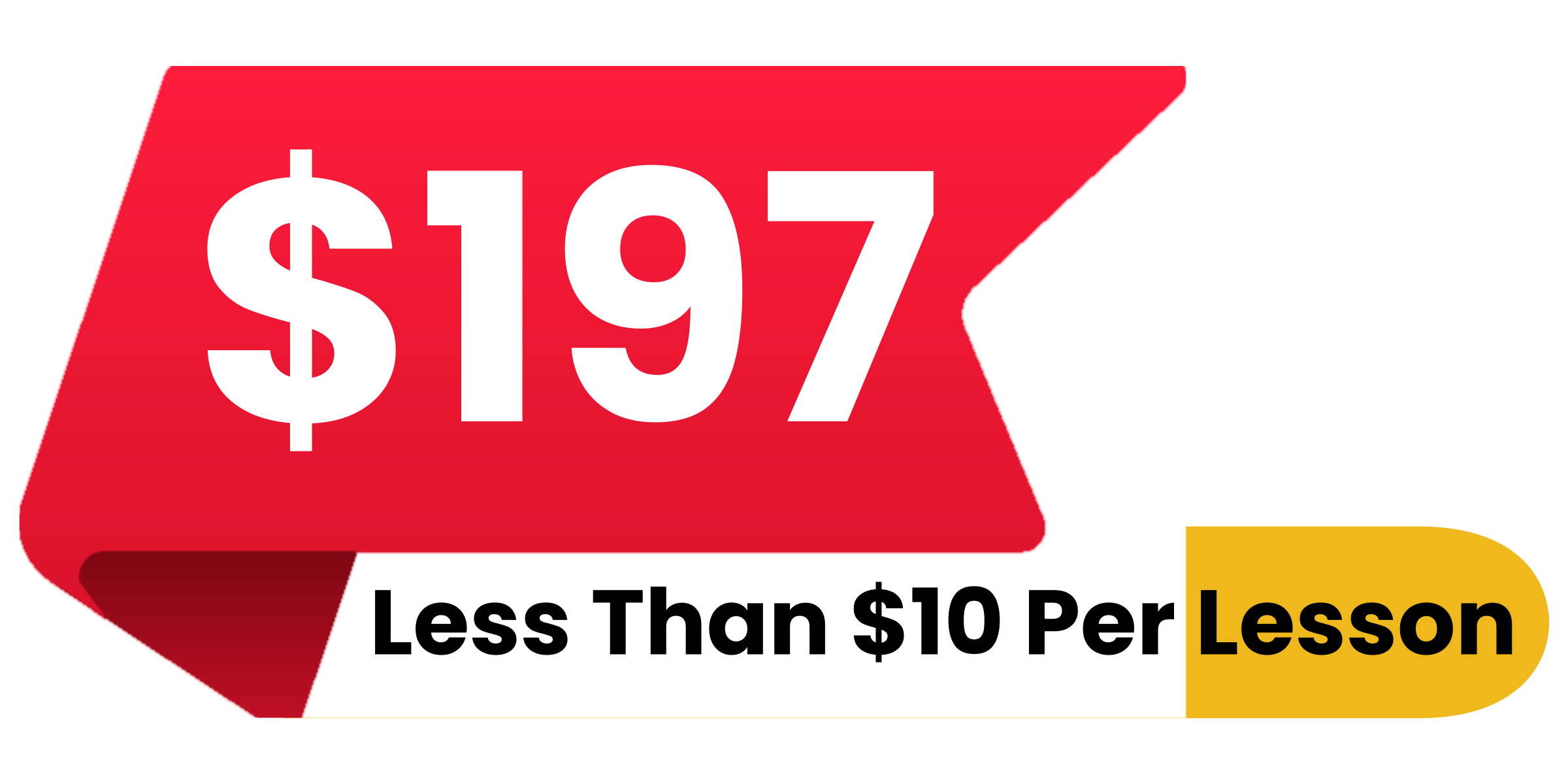
For a small investment of $197 for the entire 4-week Bootcamp, you’ll receive daily live instruction, personalized feedback, and a structured pathway to English fluency in a small-group environment.
20 live, small-group sessions focused on speaking and real-world skills
Weekly confidence-building practice speaking days
Direct access to your dedicated coach
Personalized homework feedback and comprehensive unit reviews
Certificate of completion
BONUS: Weekend Community Practice Opportunities
Investing in the Speak English Accelerator Bootcamp means investing in your future. Imagine the career advancements, social connections, and opportunities you could unlock by becoming fluent in English. This Bootcamp equips you with the skills and confidence to communicate freely in any English-speaking situation
Limited Spots Available: 5 per Bootcamp
Next Bootcamp begins January 6, 2025.
Registration deadline is December 29, 2024.