
Upper Intermediate 2 Bootcamp
Growth Track - Level 12

Coach Shaun
What you will learn
Use narrative tenses to talk about friendships and family members, and practice telling engaging stories while reacting naturally to others’ experiences.
Talk about achievements using modals like “can” and “could,” describe emotional experiences with -ed and -ing adjectives, and write job advertisements highlighting key skills and qualities.
Use future forms and conditionals to discuss environmental issues, support arguments with reasons and examples, and write structured discussion essays about campaigns and solutions.
Ask for and give recommendations confidently, compare foods and drinks using comparatives and superlatives, and write detailed restaurant reviews describing both great experiences and when things go wrong.
All courses operate on CET (Central European Time). Times are converted to your local time, but please be aware that time shifts in your region or CET during the Bootcamp may cause your session time to adjust. For example, a class starting at 6 a.m. could move to 7 a.m. if daylight saving time changes occur.
Course schedule
Unit 39 - Who is important in your life?
Lesson 1 - Review narrative tenses (past simple, past continuous, and past perfect) to talk about the past, including connectors while, when, as.
At the end of the lesson, students can use narrative tenses to talk about a friendship.
Zoom
Unit 39 - Who is important in your life?
Lesson 2 - Review used to, positive and negative. Learn anymore, any longer and still.
At the end of the lesson, students can use used to with greater confidence. Students can talk about a family member using a variety of tenses, including used to.
Zoom
Unit 39 - Who is important in your life?
Lesson 3 - Learn to tell a story and learn language to react to stories people tell.
At the end of the lesson, students can effectively share a story about a personal experience. Students can use expressions to show interest and react to stories others tell.
Zoom
Unit 39 - Who is important in your life?
Lesson 4 - Learn to write about another person, using from...until; for / over [a period of time], during, while, meanwhile to describe periods of time.
At the end of the lesson, students can write about someone they know, using time words to describe different events in the person's life.
Zoom
Speaking Practice
Zoom
Unit 40 - Abilities and qualities
Lesson 1 - Learn can and could, positive and negative, for ability. Learn be able to / manage to [do something] positive and negative.
At the end of the lesson, students can talk about themselves and other people to describe abilities and achievements.
Zoom
Unit 40 - Abilities and qualities
Lesson 2 - Learn -ed / -ing adjectives.
At the end of the lesson, students can use -ed / -ing adjectives correctly to talk about an emotional experience.
Zoom
Unit 40 - Abilities and qualities
Lesson 3 - Learn tag questions, positive and negative, with various tenses and modal verbs.
At the end of the lesson, students use basic tag questions. Students can use correct intonation to question something or confirm something using tag questions.
Zoom
Unit 40 - Abilities and qualities
Lesson 4 - Learn to write an online job advertisement, including skills and qualities required. Learn reduced expressions for job listings.
At the end of the lesson, students can write an online advertisement, including experience needed, personality traits desired, and reduced expressions.
Zoom
Speaking Practice
Zoom
Unit 41 - The environment
Lesson 1 - Learn will, be going to for future, present continuous for future.
At the end of the lesson, students can talk about the environment using future forms.
Zoom
Unit 41 - The environment
Lesson 2 - Learn and review the zero conditional and the first conditional. Learn conditional statements with imperatives. Learn distinctions between when / if and unless for conditionals.
At the end of the lesson, students can use the zero and first conditional with if, when, or unless to talk about an environmental issue. Students can also use the imperative in a conditional statement to give an order about the present or future.
Zoom
Unit 41 - The environment
Lesson 3 - Learn to support an argument giving reasons, results and examples.
At the end of the lesson, students can talk about an environmental campaign, giving reasons, results and examples.
Zoom
Unit 41 - The environment
Lesson 4 - Learn to organize and write a discussion essay, using sequence words (first, second, third, finally), contrast words (however, on the other hand), and example words (for example, such as, like).
At the end of the lesson, students can organize and write a discussion essay about an environmental issue.
Zoom
Speaking Practice
Zoom
Unit 42 - Tell me
Lesson 1 - Learn compound nouns. Learn can / can't for permission; learn have to / don't have to for necessity.
At the end of the lesson, students can use modals of permission and necessity to talk about different ways to get around town. Students can use compound nouns related to transportation and traffic.
Zoom
Unit 42 - Tell me
Lesson 2 - Expand understanding and use of comparatives and superlatives for adjectives and adverbs. Learn just, nearly, almost, even with (not) as...as... comparisons; use intensifiers with comparatives.
At the end of the lesson, students can use comparatives and superlatives to talk about and compare different foods and drinks.
Zoom
Unit 42 - Tell me
Lesson 3 - Learn helpful language to ask for recommendations and to give recommendations.
At the end of the lesson, students can ask for recommendations of what to see and do in a city. Students can give recommendations using a variety of structures.
Zoom
Unit 42 - Tell me
Lesson 4 - Learn to write a review of a restaurant, using adjectives ending in -ed vs -ing. Learn vocabulary to describe a good experience or when things go wrong.
At the end of the lesson, students can write a positive or a negative review of a restaurant.
Zoom
Speaking Practice
Zoom

Your Path To English Fluency Starts Here - Invest in Yourself Today!
The Speak EnglishAccelerator Bootcamp
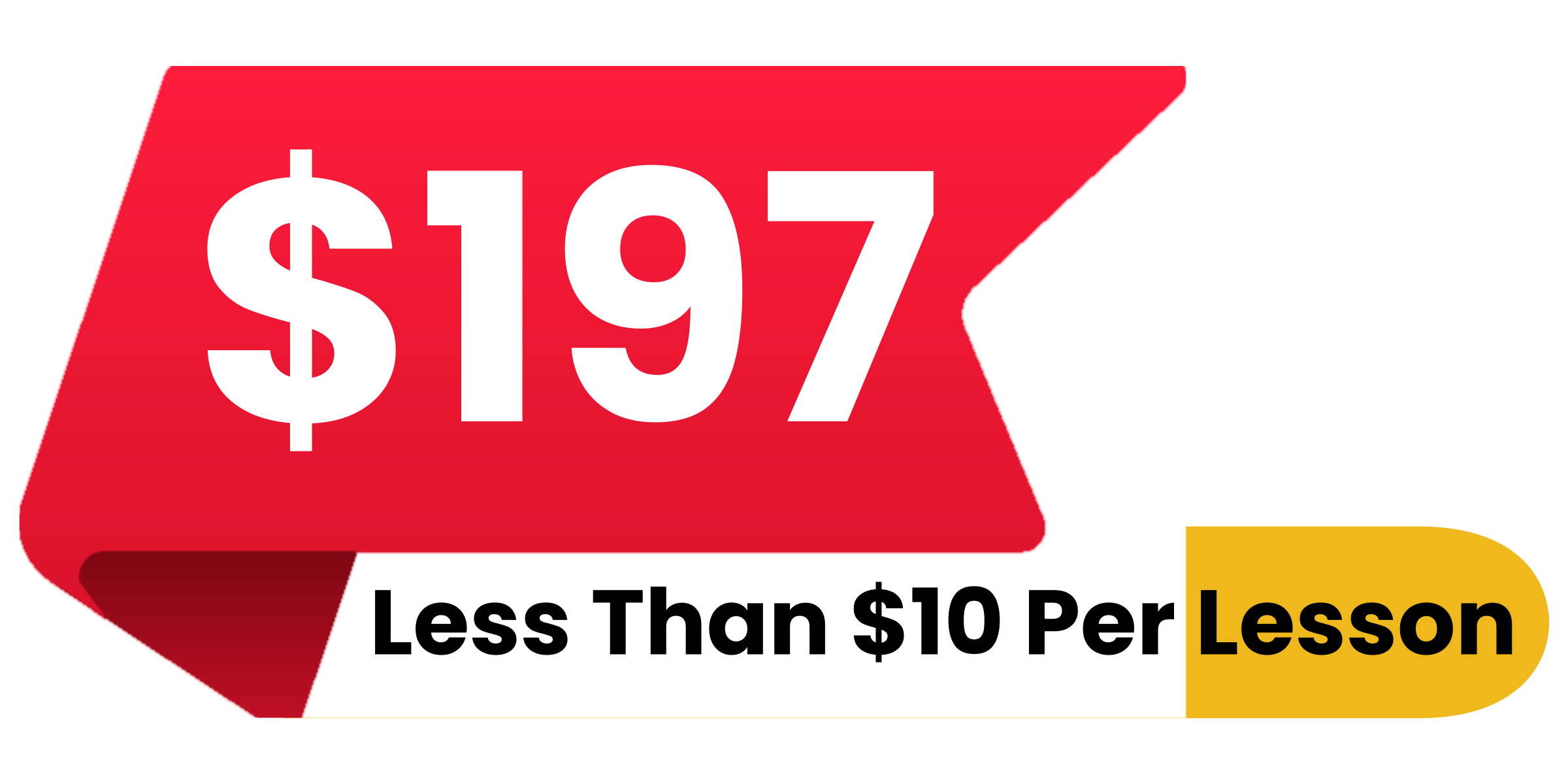
For a small investment of $197 for the entire 4-week Bootcamp, you’ll receive daily live instruction, personalized feedback, and a structured pathway to English fluency in a small-group environment.
20 live, small-group sessions focused on speaking and real-world skills
Weekly confidence-building practice speaking days
Direct access to your dedicated coach
Personalized homework feedback and comprehensive unit reviews
Certificate of completion
BONUS: Weekend Community Practice Opportunities
Investing in the Speak English Accelerator Bootcamp means investing in your future. Imagine the career advancements, social connections, and opportunities you could unlock by becoming fluent in English. This Bootcamp equips you with the skills and confidence to communicate freely in any English-speaking situation
Limited Spots Available: 5 per Bootcamp
Next Bootcamp begins January 6, 2025.
Registration deadline is December 29, 2024.